
Quick Summary
Leaking and damaged HVAC ductwork in hot attic spaces significantly drives up utility bills and creates uneven room temperatures across local households. Professional duct repair and sealing in Granite Bay by Anchor Air Duct Cleaning Service Sacramento eliminates conditioned air loss through durable mastic compound sealing, mechanical refastening, and Title 24 compliant insulation. Homeowners can restore balanced airflow and cut energy waste by contacting Anchor Air Duct Cleaning Service Sacramento for a free detailed inspection and written estimate on comprehensive duct repair and sealing.
Duct Repair and Sealing in Granite Bay: Potential Energy Savings and What to Know
Disclaimer: No authoritative public dataset identified provides Granite Bay-specific duct leakage rates, energy savings, percentages, pricing, or repair outcome estimates. Data and findings discussed below reflect broader California-wide or Sacramento-area research rather than Granite Bay-specific measurements.
During hot summer periods in Northern California, unsealed duct systems can significantly reduce HVAC performance. While housing characteristics vary across communities, California studies have reported duct leakage exceeding 20 percent in some systems, with an average leakage of 15.5 percent measured across participating sites in one state evaluation. Repairing damaged flex lines, securing loose sheet metal collars, and applying mastic paste helps keep conditioned air inside the living space rather than losing it to unconditioned attic spaces.[3]
Beyond potential reductions in monthly utility bills, properly sealed ducts can help stabilize indoor temperatures across rooms. Sealing may also reduce pollutant and dust entry through return leaks, though overall indoor air quality results depend on duct location, filtration, ventilation, and general HVAC condition.
What Is Duct Repair and Sealing in Granite Bay?
Quick Answer: Duct repair and sealing involves locating air leaks, repairing crushed or separated ductwork, and sealing joints with fiber-reinforced mastic compound or aerosol sealant. This process minimizes conditioned air loss into unconditioned attics or crawlspaces. Sealing may reduce the entry of attic dust through return leaks, though outcomes depend on duct location, filtration, and system condition.
In residential HVAC systems, air ducts expand and contract during seasonal temperature swings. Over time, standard tape adhesives can degrade, sheet metal fasteners may loosen, and flexible ducting can sag or tear. As specialists at Anchor Air Duct Cleaning Service Sacramento note, professional duct repair addresses physical damage directly, followed by sealing seams, elbows, and plenum connections to establish a more airtight distribution system.
Why Airtight Ductwork Matters in Hot-Climate Attics
Attic spaces across hot interior California climates can reach high temperatures during peak summer afternoons. When supply ducts leak in unconditioned spaces, cooling capacity is lost. Leaks on the return side can also pull warm, dusty attic air into the duct stream. California Energy Commission evaluations have noted an average duct leakage of 15.5 percent across participating study sites, compared to state efficiency targets. Sealing these breaches helps prevent unnecessary heat gain and supports indoor comfort during periods of high cooling demand.[1]
Signs Your Ductwork May Need Sealing or Repair
Need duct repair and sealing in Granite Bay?
We’re available now — call for a fast, free estimate.
Duct issues often develop out of sight behind drywall or under attic insulation. When a system is leaking or disconnected, several indicators may point to the need for evaluation.
Uneven Room Temperatures and Airflow Issues
If certain rooms stay uncomfortably warm while others remain cool, uneven delivery or duct restrictions may be present. Long flex duct runs across sprawling floor plans can experience kinks, sharp bends, or loose distribution boxes that restrict airflow to distant registers.
Musty Odors and Dust Accumulation
Leaky return plenums can draw air from attics or crawlspaces into the air stream. Sealing return leaks may reduce the entry of attic dust, insulation particles, or outdoor pollen, although overall air quality and dust levels also depend on filtration efficiency, home ventilation rates, and baseline HVAC condition.[4]
High Energy Bills and Extended AC Cycles
When an air conditioning system draws in hot attic air or loses conditioned air through leaks, run cycles can lengthen. In a 24-home Sacramento-area field study cited by Anchor Air Duct Cleaning Service Sacramento, researchers found that average delivery efficiency increased from 64 percent to 76 percent and HVAC energy use fell by 18 percent after duct retrofits. However, repair outcomes vary by home, and leaking ducts are not necessarily the primary cause of high utility bills in any individual residence.[5]
Professional Mastic Sealing vs. Basic Quick Fixes
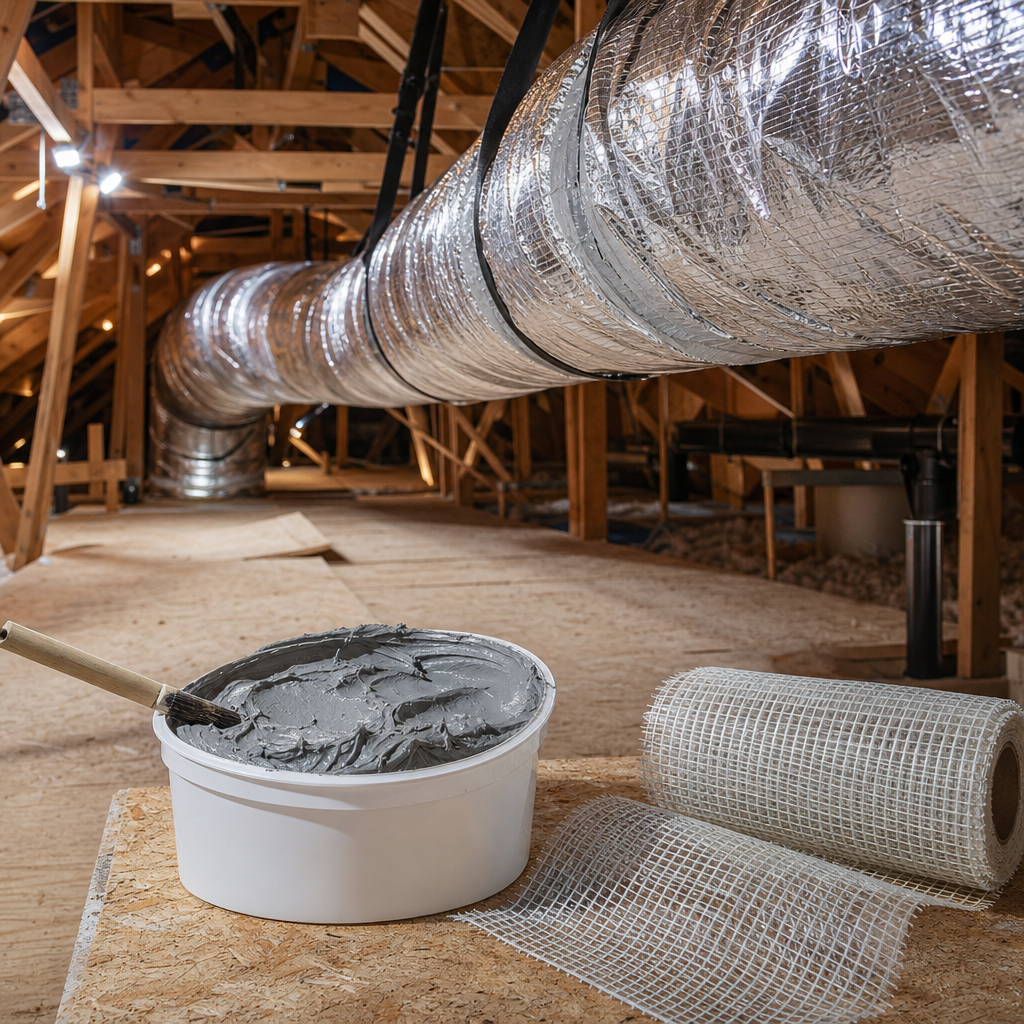
Older duct installations frequently used standard cloth-backed duct tape. Under the sustained heat of attic environments, rubber-based adhesives in cloth tape tend to dry out and degrade over time. Professional sealing utilizes materials designed to maintain performance under thermal stress.
| Feature | Standard Cloth Tape | Foil-Backed HVAC Tape | Mastic Compound & Fiberglass Mesh |
|---|---|---|---|
| Adhesion Longevity | Degrades rapidly in high attic heat | Moderate durability on clean metal surfaces | Typically more durable when properly applied |
| Flexibility | Dries out, cracks, and peels over time | Can wrinkle and lift along edges | Elastomeric; flexes with duct thermal movement |
| Leak Prevention | Poor long-term seal reliability | Fair on clean, flat, straight seams | Strong seal on irregular joints and collars |
Note: Material performance and seal longevity depend significantly on proper surface preparation, installation quality, specific materials used, and ambient operating conditions.
Mastic Paste and Aeroseal Technologies
For accessible ductwork, technicians typically apply fiber-reinforced mastic paste over fiberglass mesh tape to create a durable, airtight seal across sheet metal joints, branch takeoffs, and plenum connections. For inaccessible duct runs behind walls or between floors, aerosol-based sealing injects sealant particles directly into the pressurized duct system. In a California commercial-building analysis by Lawrence Berkeley National Laboratory, aerosol sealing achieved a 70 to 90 percent reduction in duct leakage, though results vary depending on system type, baseline leakage, and building conditions.[2]
Static Pressure and Airflow Considerations
Sealing duct leaks changes the pressure dynamics within a forced-air system. In some systems, sealing leaks without evaluating airflow balance can alter external static pressure across the indoor coil and blower. According to Anchor Air Duct Cleaning Service Sacramento, professional testing and balancing may be appropriate because actual post-repair performance depends on overall system configuration, duct sizing, and baseline operating conditions.
California Title 24 Compliance
California began requiring duct leakage testing and sealing for covered HVAC systems in 2001, expanding these requirements to existing duct systems undergoing alteration in 2005. Current compliance requirements, verification procedures, and testing thresholds depend on the specific project scope, permit date, applicable code edition, and local building jurisdiction.
Factors Influencing Duct Repair and Sealing Costs
Need duct repair and sealing in Granite Bay?
We’re available now — call for a fast, free estimate.
Because no public dataset provides Granite Bay-specific pricing, costs must be evaluated on an individual project basis. Key factors influencing project scope and cost include:
- Attic Access and Layout: Low clearances, complex rooflines, and deep insulation increase labor time required to locate and seal duct runs.
- Duct Material and Condition: Sheet metal connections may require mechanical refastening, while severely damaged or degraded flexible duct sections may require replacement.
- Number of HVAC Zones: Homes with multiple systems, zoned dampers, or multiple return drops require additional diagnostic access and testing.
- Sealing Method: Manual mastic application on accessible runs involves different labor and equipment requirements compared to pressurized aerosol sealing.
Overview of the Duct Repair and Sealing Process
A typical professional duct repair follow a structured diagnostic workflow:
-
Step 1: Visual and Diagnostic Inspection
Technicians from Anchor Air Duct Cleaning Service Sacramento inspect supply plenums, return drops, branch connections, and boot fittings to locate disconnected runs, crushed sections, or deteriorated seals.
-
Step 2: Mechanical Repair and Realignment
Physical duct components are mechanically fastened and aligned. Sheet metal joints are secured with appropriate fasteners, sagging flexible runs are supported to prevent kinks, and loose boots are refastened to framing.
-
Step 3: Mastic and Mesh Application
Technicians apply elastomeric mastic paste and fiberglass mesh to accessible seams, takeoffs, and joints before securing external insulation jackets to limit thermal losses.
-
Step 4: Airflow and System Evaluation
Following repair, system testing and airflow evaluation may be conducted to verify that air distribution and static pressure remain within appropriate operating ranges for the equipment.
Frequently Asked Questions
How long does a professional duct repair and sealing service take?
Non-research-based contractor estimates generally suggest that simple residential projects may take four to eight hours, while complex or multi-system homes may require one to two days. Actual project duration requires local contractor verification based on home layout and duct condition.
Can repairing leaking ductwork help with temperature balance in multi-story homes?
Addressing duct leakage and disconnected runs can improve air delivery to distant registers, but overall temperature balance depends on system design, zoning, duct sizing, and insulation levels.
What is the difference between Aeroseal duct sealing and manual mastic sealing?
As explained by Anchor Air Duct Cleaning Service Sacramento, manual mastic sealing is applied by hand using paste and mesh on accessible ductwork in attics, crawlspaces, and equipment closets. Aerosol sealing pressurizes the duct network and introduces sealant particles internally, sealing leaks across both accessible and inaccessible duct sections.
Does California Title 24 require duct testing for all HVAC repairs?
California Title 24 requires duct leakage testing and sealing under specific conditions established in the energy code, initially introduced in 2001 and expanded in 2005. Whether testing is mandatory depends on the project scope, permit requirements, applicable code edition, and local jurisdiction rules.
Need duct repair and sealing in Granite Bay?
We’re available now — call for a fast, free estimate.
Sources
- [PDF] 2025 NRCA-MCH-04-A Duct Leakage – California Energy Commission – energy.ca.gov (2025)
- [PDF] Cost-Effective Duct Retrofit & Leakage Reduction – MN.gov – mn.gov (2005)
- Sealing HVAC Ducts With Aerosol Sealant – www2.lbl.gov
- PDF Remote Duct Sealing in Residential and Commercial Buildings: Saving … – energy.gov
- Field Measurements of Efficiency and Duct Retrofit … – aceee.org
Duct Repair and Sealing in Nearby Cities
We also serve the communities around Granite Bay:
- Duct Repair and Sealing in Sacramento
- Duct Repair and Sealing in Antelope
- Duct Repair and Sealing in Arden-Arcade
- Duct Repair and Sealing in Auburn
- Duct Repair and Sealing in Cameron Park
- Duct Repair and Sealing in Carmichael
- Duct Repair and Sealing in Citrus Heights
- Duct Repair and Sealing in Davis
Frequently Asked Questions
How long does professional mastic duct sealing last in hot attic environments?
Unlike standard cloth duct tape that degrades quickly under high attic temperatures, professional elastomeric mastic compound and fiberglass mesh can last 15 to 20 years or more. Anchor Air Duct Cleaning Service Sacramento applies commercial-grade mastic paired with Title 24 compliant insulation to prevent future cracking and air leakage caused by seasonal thermal expansion.
When does damaged flexible ductwork require replacement instead of just sealing?
If flexible ducting suffers from crushed internal cores, extensive rodent damage, or deteriorated outer insulation jackets, full section replacement is necessary because surface sealing cannot restore proper airflow dynamics. Anchor Air Duct Cleaning Service Sacramento inspects each run to mechanically refasten salvageable sheet metal and replace crushed flex lines with properly sized, energy-efficient ducting.
How do I get an assessment for duct repair and sealing in Granite Bay?
Homeowners can reach out directly to schedule an on-site diagnostic evaluation of their duct system, plenums, and airflow balance. Anchor Air Duct Cleaning Service Sacramento provides a free detailed inspection and written estimate to identify disconnected runs, measure leakage potential, and outline permanent repair solutions.
About the author
 |
Sarah Jenkins Sarah is a home improvement and HVAC maintenance writer with five years of experience creating practical guides for homeowners. With a background in environmental science from UC Davis, she specializes in translating complex indoor air quality concepts into actionable advice. Her work focuses on helping families make informed decisions about routine and emergency HVAC maintenance. |
Dusty vents or weak airflow at home?
We’re available now — call for a fast, free estimate.
Call Now - Free Estimate