
Quick Summary
This guide explains the standards and technical processes behind professional air quality sanitizing in Fair Oaks to eliminate dust, allergens, and microbial contaminants from residential HVAC systems. Anchor Air Duct Cleaning Service Sacramento emphasizes that thorough negative-pressure mechanical extraction must precede any EPA-registered antimicrobial application to safely improve indoor air quality without ineffective chemical fogging. Readers will learn how to evaluate HVAC components, avoid low-cost bait-and-switch tactics, and contact Anchor Air Duct Cleaning Service Sacramento for a transparent, free written estimate.
Air Quality Sanitizing in Fair Oaks – Breathable, Clean Air
When considering air quality sanitizing in Fair Oaks, remediation methods should be based on documented system conditions. Depending on findings from a visual inspection and moisture check, physical debris extraction under negative pressure and EPA-registered antimicrobial treatments may be used when appropriate and supported by applicable industry standards.[4]
According to the Sacramento Metropolitan Air Quality Management District (SMAQMD), Sacramento County and regional monitoring data serve as the closest authoritative public statistics for communities like Fair Oaks. SMAQMD records indicate that Sacramento County has met the federal PM10 air-quality standard since 2002 and is designated in attainment for carbon monoxide, nitrogen dioxide, and sulfur dioxide. However, ambient outdoor metrics such as regional PM2.5, PM10, and ozone levels do not establish indoor duct contamination, the percentage of homes needing sanitizing, or the effectiveness of a specific cleaning service. As noted in U.S. Environmental Protection Agency (EPA) guidance, blanket chemical treatments are not universally recommended for residential ductwork, and internal duct insulation that has sustained mold growth cannot be effectively sanitized and must be removed and replaced.[1]
What Does Air Quality Sanitizing Involve?
Air quality sanitizing is an optional HVAC maintenance process that may be performed alongside mechanical cleaning when supported by an inspection. As practiced by industry specialists like Anchor Air Duct Cleaning Service Sacramento, under standards from the National Air Duct Cleaners Association (NADCA), mechanical source removal involves placing the duct system under continuous negative vacuum pressure to extract accumulated debris. Once trunk lines are cleaned, technicians may apply an EPA-registered antimicrobial treatment to non-porous duct surfaces if biological growth or odor-causing bacteria are confirmed.[2]
Indoor air systems can accumulate household dust, pollen, and pet dander over time. When organic debris gathers near damp HVAC components such as cooling coils, musty odors and microbial growth may develop. Sanitizing procedures are intended to address verified contaminant sources rather than achieve full sterilization of a residential system.
Mechanical Extraction and Antimicrobial Applications
Industry standards, including guidance from the EPA and NADCA, emphasize that antimicrobial treatments should not be applied over layers of dust and debris. If sanitizing agents are utilized, mechanical cleaning must occur first so that treatments can make contact with duct surfaces.
Considerations Regarding Chemical Fogging
Aerosol chemical fogging without prior mechanical debris extraction is not recommended by industry guidelines. Applying chemical mists directly over existing debris layers may create damp residue that can trap moisture rather than resolve indoor air problems. Direct source removal should be evaluated first, ensuring any subsequent EPA-registered product application is performed according to label directions and industry standards.
| Feature | Chemical Fogging Only | Standard Utility Vacuum | Commercial Negative-Pressure Extraction |
|---|---|---|---|
| Debris Removal | None | May offer limited, superficial debris capture | Provides continuous source removal through trunk lines when properly configured |
| Antimicrobial Contact | May be blocked by unaddressed dust and debris | May leave residual debris that impedes surface contact | Enables direct application onto cleaned, bare duct surfaces |
| Indoor Dust Containment | Aerosolized droplets may enter living spaces | Risks exhausting fine particles back into indoor air | Captures dislodged particles outside or through HEPA-filtered containment units |
Source Removal Vacuum Methods
Professional source removal, such as that provided by Anchor Air Duct Cleaning Service Sacramento, commonly employs truck-mounted or portable negative-air units combined with mechanical agitation tools, such as rotary brushes or air whips, when supported by an inspection. Technicians seal registers to direct airflow and draw dislodged particulates directly into collection equipment, helping to prevent dust from escaping into occupied living areas.[3]
HVAC Components Evaluated During Inspection
Need air quality sanitizing in Fair Oaks?
We’re available now – call for a fast, free estimate.
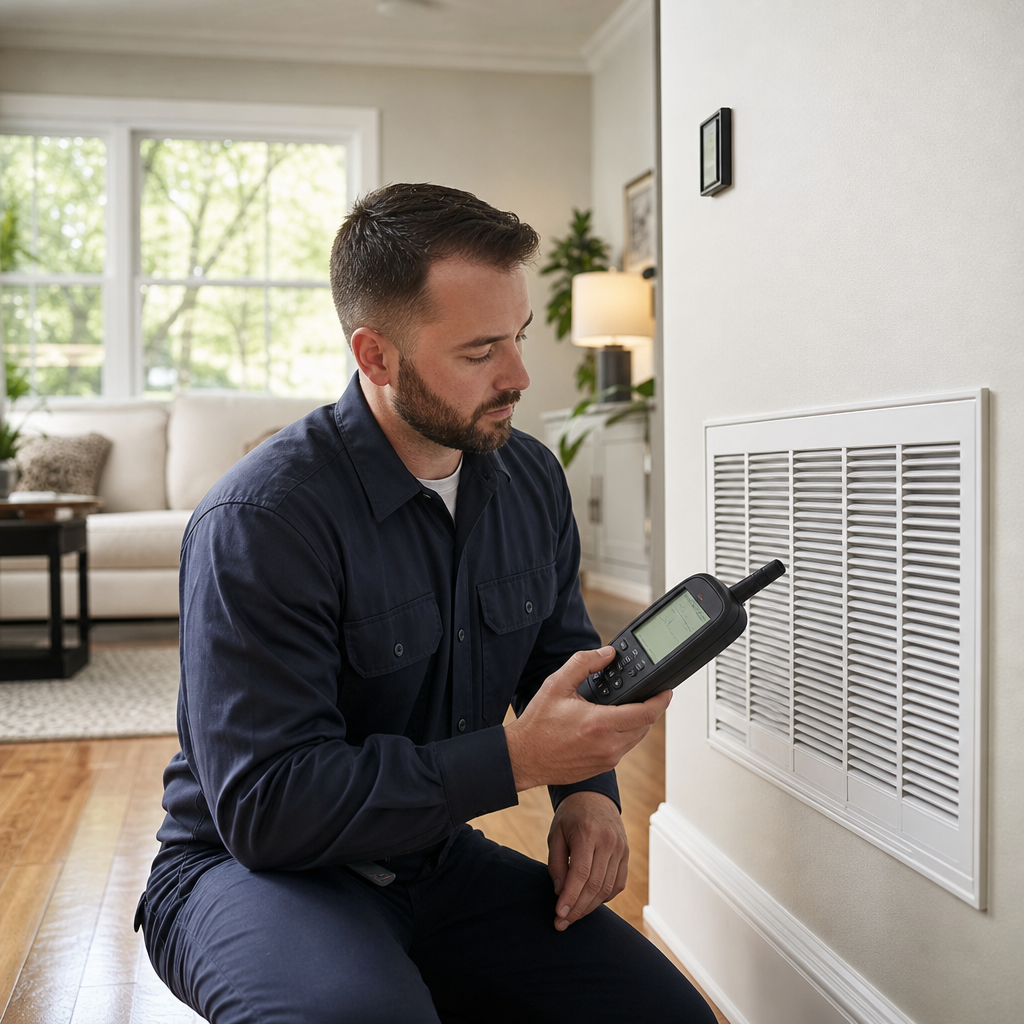
Qualified technicians inspect system components where moisture and debris typically collect before recommending cleaning or sanitizing services.
Evaporator Coils and Condensate Drain Pans
The evaporator coil removes heat and condensation from indoor air. Accumulated dust on damp coil fins or standing water in drain pans can foster microbial growth and odors. Service for these components may include mechanical brushing, clearing drain lines to prevent standing water, and applying coil-safe, EPA-registered treatments where appropriate.
Supply and Return Duct Runs
Return ducts collect ambient indoor air, while supply ducts distribute conditioned air throughout the structure. Both sections should be checked for loose connections, structural damage, and moisture. In accordance with EPA guidelines, if internal porous fiberglass insulation exhibits mold contamination, it cannot be effectively treated with antimicrobial sprays and must be removed and replaced.
Blower Motor Assemblies and Housings
The blower assembly circulates air across the heat exchanger and through the duct network. Dust accumulation on blower blades can restrict airflow and reduce operating efficiency. When warranted by an inspection, technicians remove and clean the blower wheel and housing to help restore proper air movement.
Evaluating Air Duct Cleaning and Sanitizing Costs
Costs for duct cleaning and sanitizing depend on individual home characteristics and system conditions. Key factors include the total number of registers, single or multi-zone configurations, duct accessibility, system layout, and whether components like evaporator coils require specialized cleaning.
Hiring Best Practices
Homeowners should request detailed written estimates that itemize mechanical cleaning, component servicing, and any recommended antimicrobial treatments. Clear documentation of inspection findings and verification of product-label compliance help ensure that recommended services match the actual needs of the HVAC system.
How to Select an Air Duct Cleaning Contractor
Selecting a qualified contractor helps protect HVAC equipment and ensures that any chemical applications comply with regulatory standards.
Consumer Considerations
Homeowners should exercise caution with promotional offers that promise complete system cleaning at unusually low rates. Low-cost offers may involve incomplete cleaning methods, inadequate containment, or the application of unverified deodorizers without proper mechanical source removal.
Recommended Verification Steps
Before hiring a service provider, consider the following steps:
- Appropriate equipment: Confirm the contractor uses dedicated negative-air extraction equipment with HEPA filtration when exhausting indoors, consistent with NADCA guidelines.
- Licensing and insurance: Homeowners should verify applicable California licensing, insurance, and qualifications with the relevant state and local authorities.
- Itemized written estimates: Obtain a written scope of work detailing mechanical extraction methods, specific components to be cleaned, and any EPA-registered products proposed.
- Documented inspection findings: Request visual documentation or inspection reports showing the condition of ductwork, coils, and blower components before and after service.
Frequently Asked Questions
What is the difference between standard duct cleaning and air sanitizing?
According to EPA and NADCA guidance, standard duct cleaning focuses on mechanical source removal to extract dust, dirt, and particulate matter from HVAC systems. Air sanitizing is an optional secondary process where an EPA-registered antimicrobial product is applied to address verified bacterial or fungal contamination on clean, non-porous surfaces. Sanitizing is not a substitute for mechanical debris removal.
Are duct sanitizing agents safe for use in residential systems?
Any antimicrobial product used in an HVAC system must be EPA-registered specifically for that intended use and applied strictly in accordance with its manufacturer label instructions. Safety, drying times, and ventilation requirements depend on the specific product formulation, and technicians must follow all label precautions during application.[5]
How often should ductwork be cleaned or sanitized?
According to research and guidance from the EPA, there is no universal schedule or recommended interval (such as every three to five years) for routine duct cleaning. Duct cleaning should be considered based on inspection findings, such as substantial visible mold growth on hard-surface ducts, vermin infestations, or significant dust and debris accumulations that restrict airflow or discharge into living spaces.
Does air sanitizing permanently eliminate mold in air ducts?
According to EPA guidance, cleaning and antimicrobial treatments may reduce contaminants or musty odors, but they do not guarantee permanent mold elimination. Mold will recur if the underlying moisture source is not corrected. Long-term remediation requires identifying and fixing moisture issues, such as condensate leaks or high humidity, and replacing any wet or moldy internal duct insulation.
For improved indoor air quality, homeowners consulting experts such as Anchor Air Duct Cleaning Service Sacramento should prioritize documented mechanical source removal, transparent pricing, and strict adherence to EPA guidelines and product labels.
Need air quality sanitizing in Fair Oaks?
We’re available now – call for a fast, free estimate.
Sources
- AirCompare – www3.epa.gov
- iADAM Top 4 Summary – arb.ca.gov
- Air Quality Trends – airquality.org (2026)
- Federal Planning – airquality.org (2033)
- State of the Air 2024 – lung.org (2024)
Air Quality Sanitizing in Nearby Cities
We also serve the communities around Fair Oaks:
- Air Quality Sanitizing in Sacramento
- Air Quality Sanitizing in Antelope
- Air Quality Sanitizing in Arden-Arcade
- Air Quality Sanitizing in Auburn
- Air Quality Sanitizing in Cameron Park
- Air Quality Sanitizing in Carmichael
- Air Quality Sanitizing in Citrus Heights
- Air Quality Sanitizing in Davis
Frequently Asked Questions
What happens if mold is discovered inside porous fiberglass duct lining during an inspection?
In accordance with EPA standards, mold-contaminated porous fiberglass insulation cannot be effectively sanitized with antimicrobial sprays and must be removed and replaced. Anchor Air Duct Cleaning Service Sacramento documents these structural conditions during initial inspections to provide transparent recommendations for necessary repairs or component replacements.
Why is chemical fogging alone insufficient for resolving indoor air issues in Fair Oaks homes?
Aerosol fogging without prior mechanical debris extraction merely applies chemicals over dust and pollen layers, which can create damp residue that promotes future bacterial growth. Anchor Air Duct Cleaning Service Sacramento utilizes commercial-grade negative-pressure extraction to remove all physical contaminants before applying any EPA-registered antimicrobial treatments to bare surfaces.
How does negative-pressure extraction protect living spaces from dust during duct sanitizing?
Technicians seal registers throughout the home and connect high-powered negative-air vacuums equipped with HEPA filtration to the main trunk lines. This creates continuous inward suction, ensuring dislodged particulates and allergens are pulled directly into contained collection units without escaping into occupied rooms.
About the author
 |
David Matthews David Matthews is a certified HVAC technician and indoor air quality specialist with over a decade of experience serving the Sacramento area. He holds an associate degree in Heating, Ventilation, Air Conditioning, and Refrigeration from American River College. David is passionate about helping homeowners improve their health and safety through proper duct and vent maintenance. |
Dusty vents or weak airflow at home?
We’re available now - call for a fast, free estimate.
Call Now - Free Estimate